


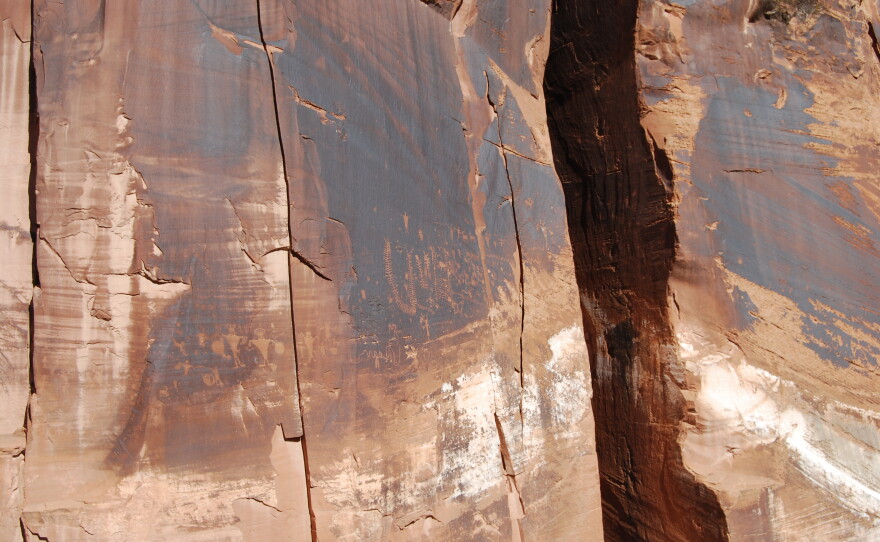
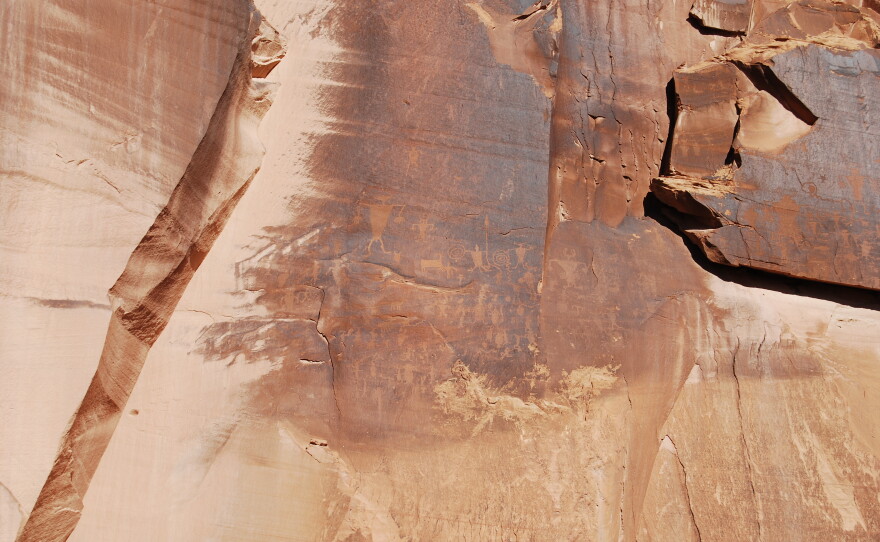
On a hot, windy day at a popular recreation area along the Colorado River near Moab, Utah, Rachel Smith is using her binoculars to look at a petroglyph panel high up on a canyon wall. I ask her if she’s looking to see if anything’s different from when she saw it last.
“Yeah, and also just for my own enjoyment,” she answers. “But yeah, I don't— I didn't see anything.”
Smith, a volunteer with the Utah Cultural Site Stewardship Program, monitors about 15 different cultural, archaeological, or historical sites across the Colorado Plateau. She says she notices something new every time she visits.
“You become kind of intimate with them and notice them in different seasons and different light,” she said. “I have some sites where I've been to dozens and dozens of times, and then the light shifts… and it's like it reveals itself in different layers.”
Volunteers go through either a virtual or in-person training, then go out in the field with state officials to better understand how to document these sites, the kinds of damage they’re looking for, and how to interact with any visitors they meet. Then, they’re assigned archaeological and cultural sites, like these petroglyphs, which they visit at least four times a year. Like all volunteers, Smith uses an app to document the area.

“I can take, sort of my baseline photographs, but I can also report anything that I'm concerned about, like new social trails,” she said. “Or I've been to some of my sites where some people decided they're going to cut firewood from trees or there's new graffiti, anything like that.”
Smith also likes to note whether the area was very busy, if anyone was camping or recreating nearby, and whether there’s graffiti or rock scratching on parts of the area that aren’t strictly part of the historical site.
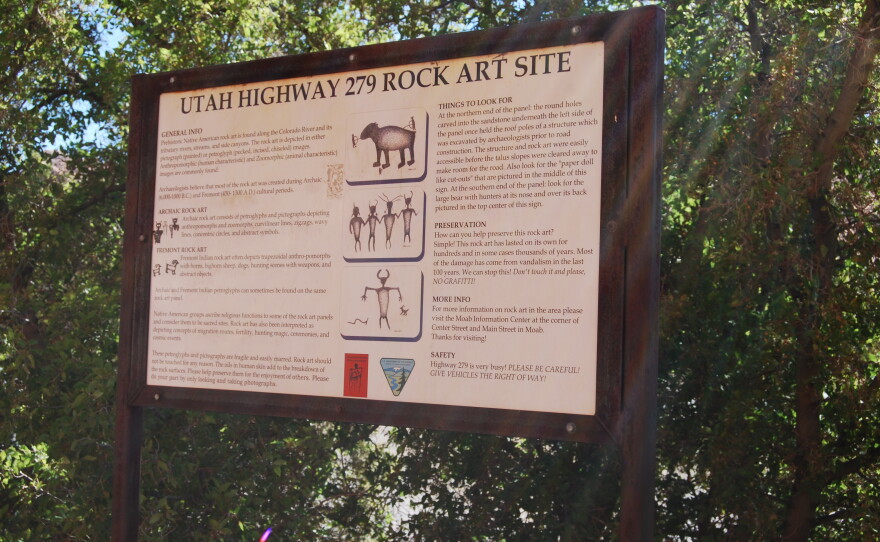
“It is part of the site environment, it's right next to the kiosk at this pull off parking area,” she said, gesturing to the marks on the rock. “It just becomes really unsightly. And then these things kind of tend to migrate to other rock walls or to other areas within the recorded site. So just, you know, trying to have people not get in the habit that that's an okay thing to do. To me, it is part of the environment. You can't extract this panel area from the river, from the other cliffs.”

If there is any new graffiti, or other issues like litter and rogue firepits, the program reports it to the land management agency responsible for the area, like the Forest Service or BLM, who will then do what they can to address the problem.
Utah’s legislature first funded the program in 2020, through the state's Historic Preservation Office. Currently, there are about 500 volunteers in the system and another 100 on a waitlist.
Smith, a retired school teacher in Grand Junction, got involved with the program very soon after its inception. She was already spending a lot of time outside hiking and camping on the Colorado Plateau, and she would regularly report any disturbances she saw at these sites.

“Before that funding… you know, you never heard back,” she said. “You never knew if a report was looked at. Now with this system, there's a lot of communication with the volunteers.”
Rachel Blumhardt, the program’s engagement specialist, said that in some cases, law enforcement has used volunteer’s reports to find artifacts that have been stolen or to prosecute vandalism.
“Or figure out at least when it was done,” she explained. “So if Rachel sends in a report today and everything looks great, there's no graffiti at this site, and she comes back in two months and there is graffiti, then we know that happened the last two months.”

All the photos, regardless of whether there’s damage to report or not, go into a database maintained by the University of Utah. Blumhardt said having all of that information can help them engage visitors even better, whether that’s putting up signs or getting more staff in the field.
“I think we'll really be able to see how management decisions in the 2020s are impacting cultural resources and hopefully we can learn from good choices and bad choices,” she said. “Reports like this, and lots of redundancy will help (us) kind of see those patterns.”
A variety of sites are included in the program, ranging from Dinah, a massive pink dinosaur sculpture in Vernal, to all of the pictographs and petroglyphs found around the Colorado Plateau, created by the ancestors of native tribes in the region.
“They've created this wheelhouse of integrating all voices that are connected to the history of Utah,” said Autumn Gillard, a Southern Paiute anthropologist, of the program. “It's something that is really great because, as descendant communities of these cultural sites, it really gives us a tangible… feeling of acknowledgement and connection to these places.”
Gillard said the program helps educate visitors about the relationships tribes have to these cultural sites, and encourages them to visit with curiosity and respect.
“Native people of Utah, Indigenous people, we are not a people of the past,” she said. “We are very much a contemporary group of Native peoples who occupy this state, and who are very interested and invested in the protection of our ancestors’ cultural belongings that they have left behind.”

Back along the Colorado River, Smith answers questions from tourists about the petroglyphs. She values being able to help people make connections to the landscape, and says volunteering has helped deepen her own connection, too.
“These places and the setting and the land and the dark skies are all part of this human story,” she said. “And to me, that's who we are as humans. We're storytellers. Being able to caretake these places that hold a piece of that story is super important to me.”
She hopes that other people will form special relationships with these places too, whether they’re just visiting, or they decide to volunteer themselves.
Copyright 2026 Rocky Mountain Community Radio. This story was shared via Rocky Mountain Community Radio, a network of public media stations in Colorado, Wyoming, Utah, and New Mexico, including Aspen Public Radio.
